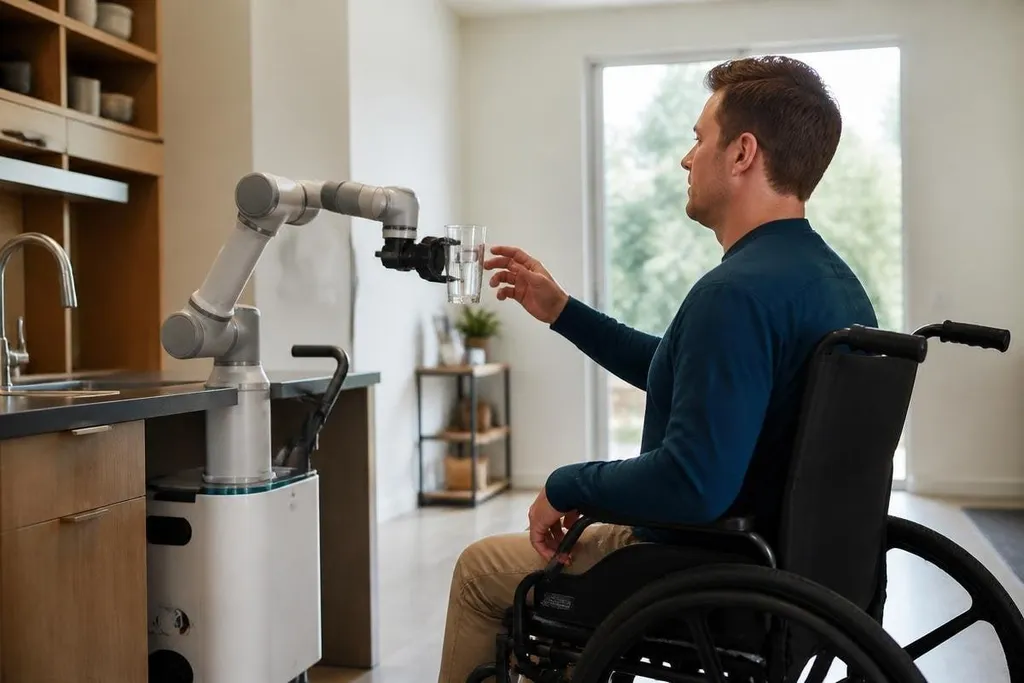
Robots that help someone move, communicate, work, or live at home can change daily choices. The rights question starts earlier: who can get the system, control it, and challenge its decisions?
- More control: assistive robots may let people do tasks without waiting for human help.
- More risk: poor design can expose movement data, limit choice, or create new safety problems.
- The main test: access, consent, cost, and accountability matter as much as the robot itself.
Assistance is also a question of choice
Robotic systems can support tasks such as lifting an object, opening a door, moving through a building, or reaching a shelf. A system that performs a task on request may give a disabled person more control over when and how that task happens.
That control matters because assistance can affect privacy and dignity. A person may want help with one task but prefer to do another without observation. The robot needs clear commands, an easy stop function, and settings that respect the person’s choices.
Care robots that decide too much can reduce independence even if they complete more tasks. The person using one should remain able to refuse an action, change the settings, and ask a human for help when the system fails.
Access has more than one price
The purchase price is only one barrier. These systems may also need a suitable home layout, reliable internet, charging space, repairs, software updates, or a trained support person. Each extra requirement can exclude people who could otherwise benefit.
Public funding and workplace rules will shape who gets access.
If an assistive robot is treated as a luxury item, people with lower incomes may wait longer or receive no support. If a workplace treats it as a private problem, a worker may have to pay for equipment that helps them do their job.
Design choices matter too. Systems that need a smartphone, precise hand movements, or strong vision may work for one person and fail another. Accessible controls should include clear physical buttons, voice input where useful, and ways to correct a mistaken command.
Safety and data need clear rules
Robots that work near people need safe limits. Mobile robots should slow down around a person, stop when their sensors detect danger, and make their status clear. Robotic arms should have defined force limits and a reachable emergency stop.
Systems used in homes may collect video, audio, location data, or records of daily routines. That information can reveal health details even when the robot was bought for a different task. People need to know what the robot records, where the data goes, how long it stays there, and who can view it.
Accountability must be clear after a failure. The maker, installer, care provider, workplace, and public agency may each control part of the system. A disabled person should not have to identify the right company before reporting harm or asking for a fix.
A rights complaint needs more than a name on a device. Robotics policy reporting can trace the system’s maker to the agency that approved its use, so a disabled person has a clear place to report an automated refusal.
The risk of automated gatekeeping
Robotics may also affect disability rights without touching a person. A hospital, insurer, workplace, or public agency could use automated systems to sort requests, assess risk, or decide who receives support.
That creates a separate problem. A fast decision can still be wrong, and a person may not know which data shaped it. Any system used this way needs a clear reason for its decision, a record that people can inspect, and a real path to human review.
The strongest opposing view is that automation can make services easier to reach when staff and money are limited. That may happen, but speed does not replace the right to appeal, receive an explanation, or get support in an accessible format.
A rights-first check
Before a robot enters a home, workplace, or public service, check these points:
- Name the user: identify who controls the robot and who can stop it.
- Test the setting: check doors, floors, lighting, noise, charging, and network access.
- Limit the data: record only what the task needs, then set a deletion period.
- Plan for failure: write down who responds when the robot stops or causes harm.
- Keep a human route: make sure the person can reach staff without using the robot.
I think the rights question should come before the robot question. A machine can give someone more freedom, but only when the person can afford it, control it, and reject its decisions.
The next measure of progress is practical: can disabled people obtain these systems, set their limits, and appeal when they fail?